
How Structured Interview Process Reduces Bad Hires
A bad hire rarely comes from a lack of effort but from an interview process that lets every panelist judge candidates on different, unspoken criteria. Here is how structured interviews fix that, what the research says about how much they actually improve hiring accuracy, how to create a structured scorecard, and how to run the process without delaying your hiring timeline.

Jyoti Shukla
Senior Sales Manager

Quick Overview
- Structured interviews ask every candidate the same core questions, in the same order, scored against the same rubric.
- Research going back to Schmidt and Hunter's 1998 meta-analysis of 85 years of hiring data puts structured interviews among the two strongest predictors of job performance, alongside cognitive ability tests.
- A 2022 re-analysis by Sackett and colleagues, published in Industrial and Organizational Psychology, still ranks structured interviews as one of the highest-validity selection methods available.
- SHRM estimates that replacing an employee typically costs 50% to 200% of that person's annual salary, the exact cost a bad hire triggers.
- AI-assisted scoring, JD-based question generation, and standardized, custom feedback scorecards, built into platforms like Talentpool's recruitment management software, let teams run structured interviews at volume without adding recruiter hours.
Introduction
Ask any hiring manager to describe their worst hire, and they will usually tell you the interview "felt fine." That is the uncomfortable truth about most bad hires. They don't fail because someone missed an obvious red flag. They fail because the interview process never asked the right interview questions in a way that let anyone compare candidates fairly.
Unstructured interviews run on gut feel. One interviewer asks about weaknesses while another asks about a recent project. Everyone walks away with an opinion, but nobody has evidence.
Structured interviews fix this without adding complexity. This guide covers what structured interviews actually are, the research behind why they work, how to build a structured interview scorecard you can start using this week, and where AI genuinely helps (and where it doesn't).
What are Structured Interviews?
A structured interview is an interview format where every candidate for a role is asked the same core set of predetermined questions, in the same order, and scored against the same rating criteria by every interviewer on the panel.
Before the first candidate ever sits down, the hiring team has already agreed on:
- What questions get asked (and roughly what a strong answer sounds like)
- What competencies those questions are meant to test
- How each competency gets scored, using a shared rating scale
- What score or combination of scores clears the bar for a "yes"
All of these are decided before the interview process starts, which is exactly what makes structured interviews comparable across candidates and defensible after the fact.
However, Good structured interviews still allow probing questions ("Can you walk me through what happened next?"). The structure lives in the core questions and the scoring, not in banning every follow-up.
Also Read: 8 Tips for Hiring Managers to Interview Candidates
Structured vs Unstructured Interviews: Key Differences
The difference between a structured and unstructured interview is not formality but whether the evaluation criteria exist before the interview happens.
| Aspect | Structured Interview | Unstructured Interview |
|---|---|---|
| Questions | Same core questions, same order, for every candidate | Improvised, varies by interviewer and mood |
| Scoring | Rated against a shared rubric/scorecard | Based on general impression, no fixed criteria |
| Predictive validity | Among the highest of all selection methods (r = 0.42–0.51) | Considerably lower (r ≈ 0.20) |
| Consistency across interviewers | High, same criteria applied to every candidate | Low, depends entirely on who's in the room |
| Legal defensibility | Strong, documented, criteria-based, comparable | Weak, hard to explain why one candidate beat another |
| Bias exposure | Reduced, evidence-based scoring limits first-impression bias | High, first impressions and affinity bias drive outcomes |
| Candidate experience | Consistent and predictable across rounds | Inconsistent, can feel arbitrary or unfair |
| Perceived speed | Feels the same or faster once templates exist | Feels faster to prep for, but debriefs run longer because there is no shared evidence to point to |
Benefits of Structured Interviews
- Less room for bias to drive the decision: When every candidate is scored against the same criteria, a strong first impression or an easy rapport can't quietly outweigh what the candidate actually said.
- Faster, less circular debriefs: Panels stop arguing about whose opinion to trust and start comparing documented evidence, which is usually what makes a 45-minute debrief turn into 90.
- A record that holds up later: If a hiring decision or a rejection ever gets questioned, a completed scorecard shows exactly what was assessed and why.
- A fairer experience for candidates: Everyone gets asked about the same things, at the same depth, regardless of which interviewer they happen to draw. Candidates notice when that's not the case, and it shows up in employer-brand feedback.
Why Structured Interviews Reduce Bad Hires?
Structured interviews reduce bad hires because they replace subjective impressions with evidence that can be compared across candidates. When every interviewer scores the same competencies against the same scale, disagreements become discussions about specific evidence instead of subjective arguments.
SHRM estimates that replacing an employee typically costs between 50% and 200% of that person's annual salary once you account for recruiting, onboarding, lost productivity, and ramp-up time. The range widens with seniority and role complexity.
Researches proves the same:
- Schmidt and Hunter's landmark 1998 meta-analysis in Psychological Bulletin reviewed 85 years of personnel-selection research covering 19 different hiring methods. Structured interviews and general mental ability tests came out as the two strongest individual predictors of future job performance, both around a 0.51 validity coefficient, well ahead of reference checks, years of experience, or unstructured interviews.
- A meta-analysis by McDaniel, Whetzel, Schmidt, and Maurer (1994) found structured interviews reached a corrected validity of 0.63, compared to just 0.20 for unstructured interviews. This means structured formats were more than three times as predictive of job performance.
- More recently, Sackett, Zhang, Berry, and Lievens (2022), published in Industrial and Organizational Psychology, revisited these older meta-analyses using more conservative statistical corrections. Even after adjusting older validity estimates downward, structured interviews still held an operational validity around 0.42, still one of the highest-validity selection tools available, alongside work samples and cognitive testing.
What this means in practice is that interview structure is not a "nice to have" for compliance but one of the few interview design choices with genuine, repeatedly replicated evidence behind it.
Core Components of a Structured Interview Process
A structured interview process has three moving parts. Get these three right and everything else, like timing, panel size, and number of rounds, is just logistics.
1. Interview Scorecards
An interview scorecard is the form every interviewer fills out, listing the specific competencies being assessed for the role, a rating for each one, and short written evidence backing up that rating. It is what turns "I liked her" into "she scored a 4/5 on stakeholder communication because she walked through how she de-escalated a client complaint without needing manager intervention."
The scorecard exists before the interview, not after it. That single sequencing choice is what separates structured interviews from a hiring manager retroactively justifying a decision they would already have made.
2. Standardized Questions
Every candidate answers the same core set of questions, tied directly to the competencies on the scorecard. If "problem-solving under ambiguity" is a scored competency, there needs to be a question that actually tests it.
Standardized doesn't mean identical word-for-word delivery with zero follow-up. It means the anchor questions are fixed, and any follow-up probes exist to get more evidence on the same competency.
3. Rating Scales
A rating scale only works if every number means the same thing to every interviewer. A vague 1–5 scale where "3 means average" produces different results depending on who is holding the pen.
A good scale defines what each number actually looks like in behavioral terms. For example, a 4 on "communication" might specifically mean "explains complex ideas clearly to both technical and non-technical audiences, with minimal follow-up needed."
This is also where calibration matters: before the hiring loop starts, the panel should agree on what a 3 versus a 4 looks like for this specific role, so two interviewers watching the same answer don't score six points apart.
How to Build a Structured Interview Scorecard?
Here's a working structured interview scorecard template you can adapt for almost any role.
Step 1: List the Competencies
Select the main 4-6 competencies that matter the most. Pull these from the job description and from conversations with the hiring manager. A sales role and a data analyst role should not share the same scorecard.
Step 2: Assign a Weight to Each Competency
Not every competency matters equally. A senior engineering hire might weight technical depth at 40% and communication at 20%; a customer-facing role might flip that.
Step 3: Define What Each Rating Level Looks Like
| Rating | Label | What it looks like |
|---|---|---|
| 1 | Does not meet bar | No relevant evidence provided, or evidence directly contradicts the competency |
| 2 | Partially meets bar | Some relevant evidence, but with clear gaps or inconsistency |
| 3 | Meets bar | Solid, relevant evidence that matches what the role requires |
| 4 | Exceeds bar | Strong evidence with clear examples of impact beyond baseline expectations |
| 5 | Significantly exceeds bar | Exceptional evidence; would set the standard for this competency on the team |
Step 4: Create Interview Questions
Step 4: Build the Scorecard
| Competency | Weight | Rating (1–5) | Evidence from candidate's answer | Weighted score |
|---|---|---|---|---|
| Core role-specific skill | 30% | |||
| Problem-solving | 25% | |||
| Communication | 20% | |||
| Collaboration / team fit | 15% | |||
| Growth mindset / coachability | 10% | |||
| Total | 100% |
Step 5: Leave Room for Written Evidence
A rating with no evidence next to it is just an opinion wearing a number. The evidence column is what makes the scorecard defensible and useful in a debrief. This is what turns individual interviews into a searchable, comparable record instead of six separate memories that fade within a week.
How to Implement Structured Interviews Without Slowing Down Hiring
- Build the scorecard once per role family, not once per requisition: If you're hiring five backend engineers this quarter, you need one scorecard, not five. Reuse it, and only tweak the questions if the role's scope genuinely changes.
- Score independently, before the group discusses: Have every interviewer submit their scorecard before the debrief starts. This cuts debrief time dramatically because the group is reconciling documented evidence, not starting the conversation from scratch.
- Time-box each interview stage: A structured 45-minute interview with four competencies and a fixed set of questions is not slower than an unstructured 45-minute conversation. It is the same time slot, better used.
- Run panels in parallel where you can: Structure doesn't require sequential rounds. Use AI interview software to conduct multiple structured interviews the same day or even simultaneously, especially for early-stage screens.
- Automate what doesn't need a human: Scheduling coordination, reminders, and first-round screening are where most hiring delays actually live, not the interview itself. Automating those steps frees up the time required for structuring.
- Calibrate once, not every cycle: A single calibration session per role family, where the panel agrees on what a 3 vs. a 4 looks like, prevents the re-interviews and second-guessing that actually slow hiring down.
Common Mistakes That Make Structured Interviews Slow
- Too many competencies per interview: Trying to assess eight things in 30 minutes means shallow evidence on all of them and a scorecard nobody trusts enough to act on quickly.
- No reusable templates: Rebuilding the question set and scorecard from scratch for every requisition is where teams lose the most time, and it is completely avoidable.
- Mandatory group consensus meetings for every hire: Requiring the full panel to sit in a room and agree in real time adds scheduling friction that has nothing to do with interview structure.
- Scoring from memory after the interview ends: Waiting until the end of the day (or the end of the week) to fill in the scorecard means interviewers are reconstructing evidence instead of recording it, which produces vaguer scores and longer debriefs.
- No calibration before the first candidate: Skipping calibration means the first two or three candidates effectively become the calibration exercise, at their expense, and at the cost of re-scoring or re-interviewing later.
Role of AI and Recruitment Software in Structured Interviewing
AI doesn't replace the judgment behind a good structured interview. It removes the administrative drag that makes structure feel like extra work. Recruitment management software has increasingly built structure directly into the hiring workflow, rather than leaving it as a separate document nobody actually opens during the interview.
A few ways this shows up in practice within an end-to-end recruitment platform like Talentpool's recruitment management software:
Custom Feedback Form Designer
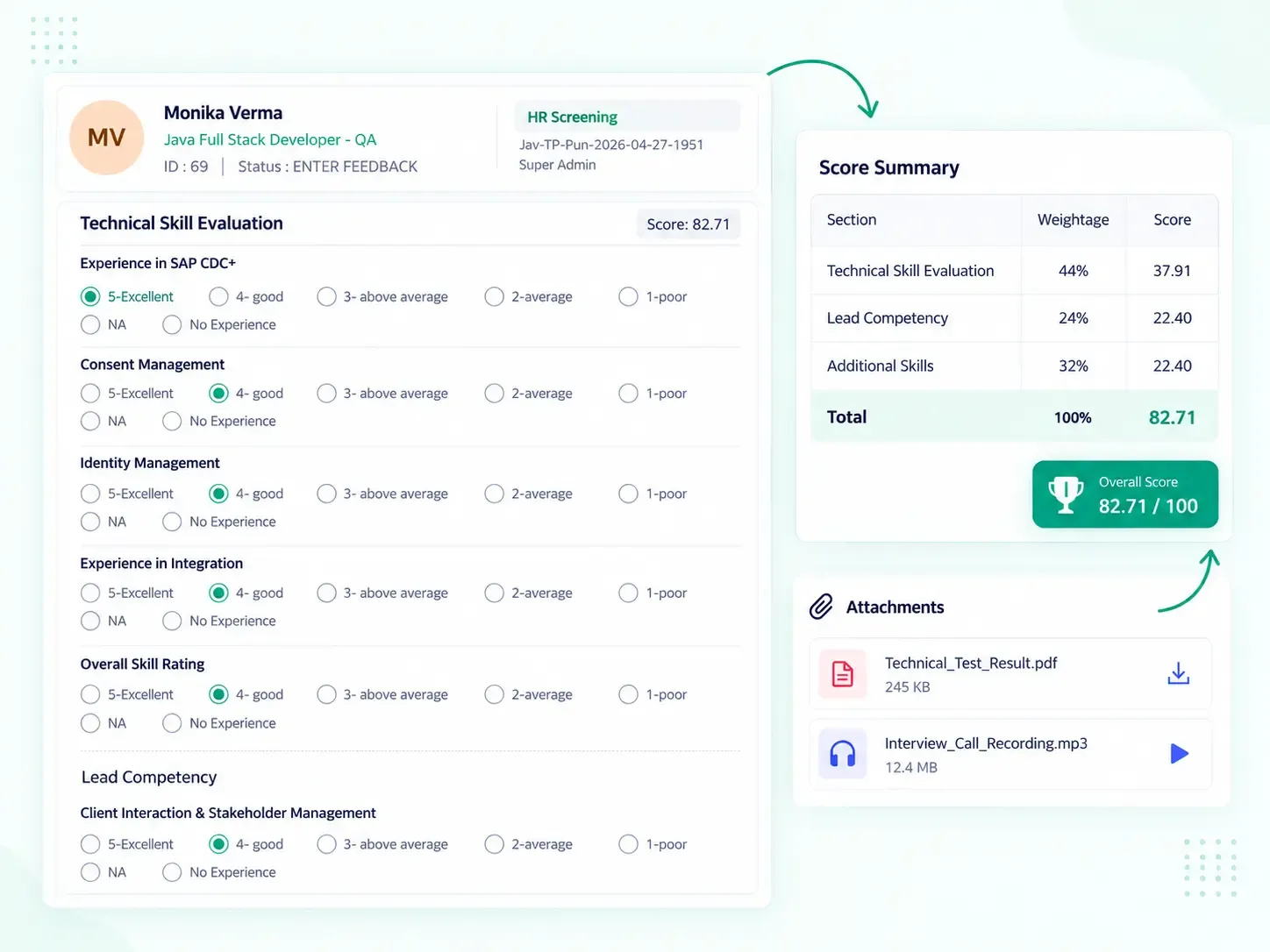
With Talentpool, hiring teams build the scorecard once, matching their existing rating structure, with weightages built in for like-for-like comparison across candidates. Leadership sees a total score per candidate per stage, not a subjective paragraph. Formula-driven, cumulative scores in Likert and point scales replace free-text opinions - reducing bias, inconsistency, and panelist ambiguity.
And it can attach test results or call recordings directly to the feedback, so the evidence and the score live in the same place.
AI Scoring
AI resume scoring applies configurable weightages across skills and experience automatically, so every candidate gets ranked against the same job-specific criteria - the same principle behind a scorecard's weighting, just applied consistently at volume.
AI Interviewer
Our AI interviewer runs first-round interviews around the clock, asking JD-based, role-specific questions with context-aware follow-ups, and produces a detailed scorecard with an audit trail for every candidate. This is structure applied automatically, at a scale no panel of humans could match for early-stage screening.
Also Read: How AI Interview Scoring Works, What It Evaluates and Why Recruiters Use It
Interview Management and AI Scheduler
While the AI interview scheduler handles the parts of the process that actually cause delays, matching candidate and panel availability, automation takes care of sending reminders and keeping an activity log. So the time saved on coordination can go toward running the interview properly instead of chasing calendars.
Because every module reads and writes to the same candidate record, a scorecard built for one role doesn't get lost between systems. It remains a part of the same applicant tracking software record the rest of the hiring team already works from.
For teams evaluating AI recruitment software or a broader talent recruitment software platform specifically to fix interview consistency, Talentpool simplifies the process with structure, automation, and customization. Schedule a no-obligation personalized demo to see how.
Conclusion
Bad hires are expensive, and the interview process is usually where the damage starts, not where it is caught. Structured interviews don't ask hiring teams to do more work. It asks teams to do the same work in a more comparable, more defensible order: decide what you are testing for before the candidate walks in, ask everyone the same core questions, and score everyone against the same scale. Teams that build the scorecard once, calibrate once, and let the right tools handle coordination reduce the risk of bad hires significantly
Frequently Asked Questions
Tags
Jyoti Shukla
Senior Sales Manager
Jyoti Shukla is a key member of the Talentpool team, bringing extensive experience in talent acquisition and recruitment technology to help companies build better hiring processes.