
Introducing Talentpool's AI Interview Scheduler: How It Works
Talentpool's AI Scheduler automates interview scheduling by having hiring managers share their available slots by email, letting candidates pick a time directly, and sending automated reminders whenever a response is overdue. This guide walks through exactly how it works and the benefits for recruiters, interviewers, and candidates.

Poushali Ganguly
Business Head
Quick Overview
- Talentpool's AI Scheduler, powered by Maya, takes over interview scheduling end-to-end- no more emailing hiring managers and candidates back and forth just to land on a time.
- Recruiters turn it on per position from Settings, so it only runs where your team actually wants it.
- Hiring managers choose slots and candidates receive those slots directly and pick a time themselves.
- If a hiring manager or candidate doesn't respond, Maya sends an automatic reminder before anyone has to chase them by hand.
- It reduces manual coordination, scheduling delays, and improves candidate experience.
Introduction
Imagine this: a recruiter shortlists the best-fit candidate and sends over a few interview slots with the hiring manager. Two days pass with no reply. By the time everyone lands on a time, the candidate has already accepted another offer.
This is the part of hiring that rarely gets the credit for slowing everything down. Nobody blames the repetitive manual coordination tasks like scheduling for a bad quarter of hiring. But it is usually one of the stages where hiring delays happen.
Talentpool's AI Scheduler, powered by our AI agent Maya, is built to close that exact gap. It has rolled out this September to hand the entire back-and-forth of interview scheduling over to automation, while still leaving recruiters in control.
How Interview Scheduling Slows Hiring Down?
It is easy to assume scheduling is a solved problem in 2026. In practice, most of it still happens over email or messages.
A recruiter emails a hiring manager for availability. The hiring manager replies two days later during peak business season. The recruiter shares those slots in a new email for the candidate. The candidate picks a time that's already been taken by someone else. The cycle restarts.
According to SHRM's 2025 Benchmarking Reports, the hiring journey from job posting to offer acceptance is already segmented into stages that consume most of the time, with screening and interviewing alone averaging 8 to 9 days combined. Every extra day spent coordinating calendars is a day added to that number, and a day a good candidate has to consider a competing offer.
This is a process problem that was never designed to scale past a handful of hires a month. That's exactly the gap the Talentpool recruitment software's AI interview scheduler is built to close.
How Talentpool's AI Scheduler Works
The AI Scheduler is designed to feel like less work at every step, not more setup. Here's the flow, start to finish.
Step 1: A recruiter turns it on for the positions that need it
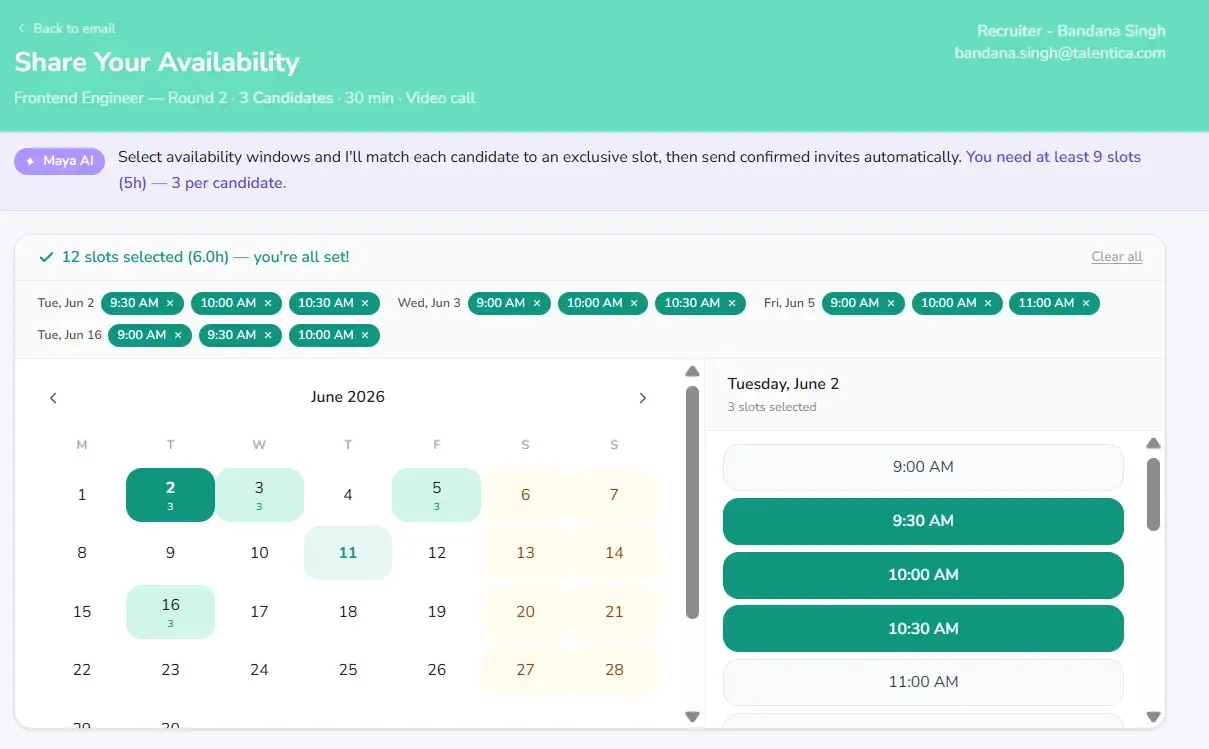
The AI Scheduler is not switched on account-wide by default. A recruiter enables it from settings and applies it to specific positions, so it fits into however your team already scopes its hiring process.
Step 2: The hiring manager gets notified
Once enabled, the hiring manager receives an email asking them to share their maximum available interview slots for that position in a calendar. They choose the slots and submit their availability once, in one place.
Step 3: The candidate picks a time that works for them
Once the hiring manager submits their slots, the candidate gets an email showing exactly those options and picks whichever one suits them. The interview is booked the moment they choose, with no recruiter intervention required.
Step 4: Automated reminders for no response
If a hiring manager or a candidate has not responded within a stipulated time, Maya sends automated reminders. This is usually where a manual process quietly stalls; here, it is handled without a recruiter needing to remember to follow up.
Step 5: If it still stalls, the recruiter steps back in
Automation doesn't mean recruiters lose visibility. If someone doesn't respond even after a reminder, the recruiter gets the option to intervene manually, reaching out directly to the interviewer or candidate. The system escalates to a human exactly when a human is needed.
Step 6: Recruiter sees the progress clearly
Recruiters get a clear, position-level view of scheduling status: what has been scheduled, what is waiting on a hiring manager, and what is waiting on a candidate. Instead of digging through inboxes to check on ten open roles, it is all in one screen.
Step 7: Entire audit trail on the candidate's card
Every step of the process, from the first email sent to the final confirmed slot, is logged as a detailed audit trail directly on that candidate's card. If anyone needs to see what happened and when, it is already there.
Manual Scheduling vs. Talentpool's AI Scheduler
| Aspect | Manual / Email Scheduling | Talentpool's AI Scheduler |
|---|---|---|
| Collecting availability | Recruiter emails each hiring manager individually and waits on replies | Hiring manager gets one email and submits all their available slots in one step |
| Sharing slots with candidates | Recruiter manually re-types availability into a fresh email to the candidate | Candidate automatically receives the hiring manager's slots and books directly |
| Following up on silence | Recruiter has to remember to chase whoever hasn't replied | Maya sends automated reminders to whoever's holding things up |
| When nobody responds | The interview quietly stalls until someone happens to notice | Recruiter gets a clear signal to step in and intervene manually |
| Checking status across roles | Recruiter checks each position separately, often across old email threads | One view shows what's scheduled, pending, or stuck, across every open role |
| Record of what happened | Scattered across inboxes and calendars, hard to reconstruct later | A complete, timestamped audit trail on every candidate's card |
Benefits of Talentpool's AI Scheduler
Less manual coordination
The recruiter's job in scheduling used to be relaying information between two people. The AI Scheduler removes that middle step entirely, freeing up time for the parts of recruiting that actually need a recruiter's judgment.
Less candidate drop-offs
A candidate who gets a clear set of times to choose from and books instantly has a very different impression of your hiring process than one stuck waiting on an email that might arrive after 3 days. Given how much of a factor speed plays in improving candidate experience and reducing drop-offs, that first scheduling experience matters more than it gets credit for.
Fewer emails for hiring managers
Busy hiring managers are far more likely to respond to a single, simple request for their availability than to a chain of emails. That alone removes one of the most common points where scheduling breaks down.
Nothing gets lost
Automated reminders mean a slow response doesn't quietly become a forgotten one. And when a reminder is not enough, the system doesn't just keep waiting but flags the recruiter to step in.
Full visibility across every role
Instead of separately checking on every open position, recruiters get one clear view of where every scheduling conversation stands. That makes it easy to spot which roles are stuck before a hiring manager or a candidate has to ask why.
AI Scheduler: Who is This Built For?
The AI Scheduler is most useful the moment a team is coordinating more interviews than one recruiter can track by memory, which, for most growing teams, happens faster than expected.
As part of Talentpool's broader AI recruitment software, it sits right alongside AI Scoring and the AI Interviewer in the funnel: candidates get scored and shortlisted, then move straight into a scheduling step that no longer depends on a recruiter's inbox.
And because it lives inside Talentpool's applicant tracking software, every scheduling action is already tied to the candidate's full record, no separate scheduling tool and no extra login for hiring managers or candidates.
If you're weighing the broader case for automating your interview process end to end, check out our guide on how to automate your interview process.
Key Takeaways
Scheduling is rarely the main reason hiring slows down, but it is consistently one of the biggest hidden sources of delay. Talentpool's AI Scheduler removes the recruiter as the middleman: hiring managers submit availability once, candidates book directly from those slots, and Maya handles the reminders.
The feature has rolled out this September as part of Talentpool's end-to-end recruitment platform. Want to get a quick walkthrough? Connect with us now at info@thetalentpool.ai!
Frequently Asked Questions
Tags
Poushali Ganguly
Business Head
Poushali Ganguly is a key member of the Talentpool team, bringing extensive experience in talent acquisition and recruitment technology to help companies build better hiring processes.