The Ultimate Guide to Values-Based Recruitment
Skills get candidates through the door, but shared values are what keep them engaged once they are in. This guide breaks down what values-based recruitment actually means, the challenges and mistakes that trip most companies up, and how to build a values-based hiring process that strengthens culture.

Poushali Ganguly
Business Head
Quick Overview
- 51% of employees are only neutrally engaged at work, and 13% are actively disengaged - a gap that values-based recruitment is specifically designed to close.
- Values-based recruitment looks at mutual fit between a candidate's beliefs and behaviors and the company's core values, without sidelining technical skill.
- Done well, it improves engagement, retention, and cultural cohesion; done poorly, it can quietly narrow diversity by rewarding people who simply resemble the existing team.
- The biggest challenge is not defining values but measuring them consistently and objectively across interviewers.
- Value-based interviewing, using structured, behavior-based questions tied to specific values, is what separates a rigorous process from a gut-feeling "culture fit" call.
- The most common mistake is treating "values fit" and "culture fit" as the same thing, when the goal should be shared principles, not shared personalities.
- Talent acquisition software can help standardize values scoring across recruiters and interview panels, so evaluation doesn't come down to who happened to run the interview.
Introduction
Do you know that 51% of employees are neutrally disengaged in the workplace, while 13% are actively disengaged?
This is a huge number. Right?
So how do hiring managers and business owners bridge the gap to ensure long-term productivity and satisfaction on both sides? The answer is values.
Value-based recruitment helps employers identify candidates whose beliefs, behaviors, and personal values complement their company.
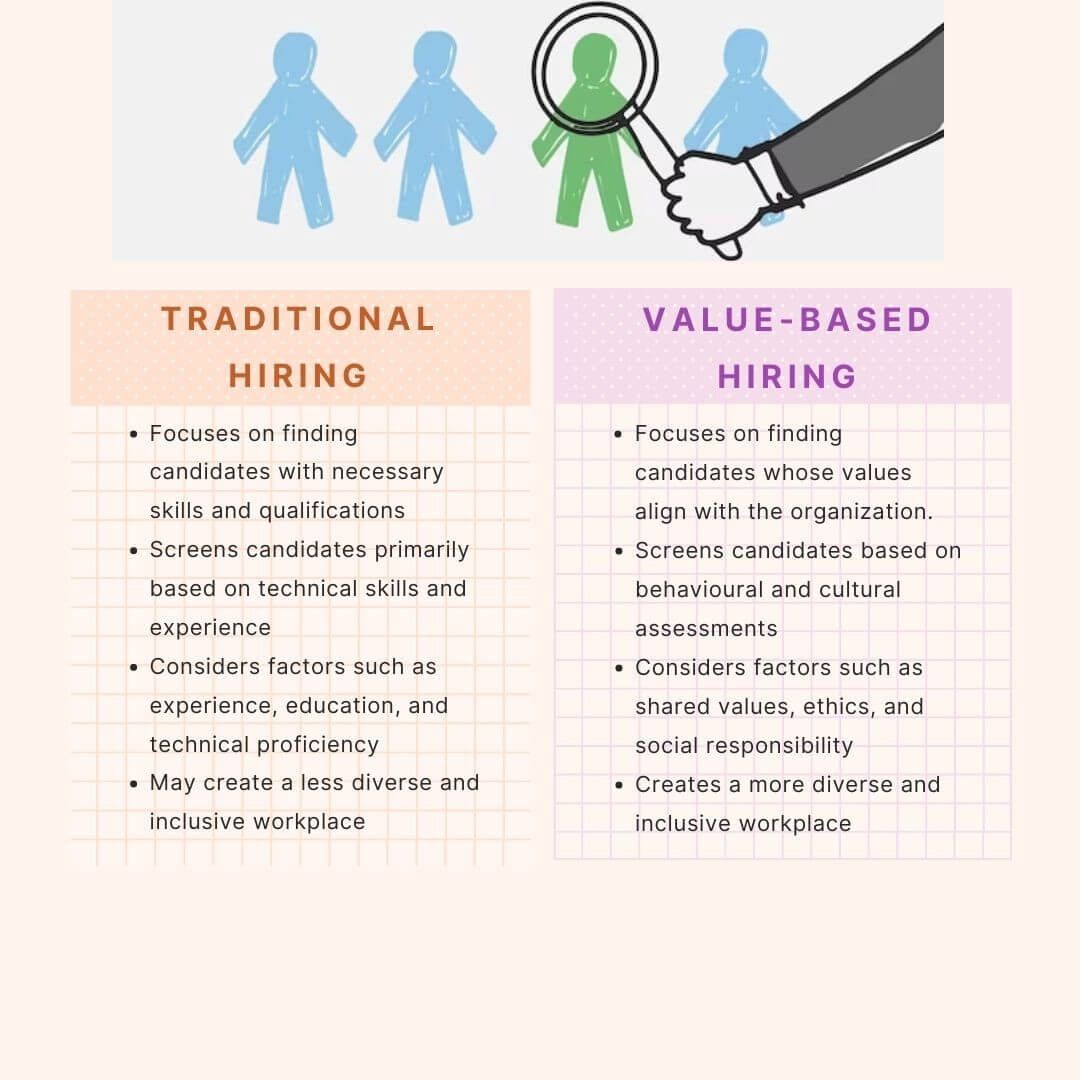
Traditional hiring practices focus more on a candidate’s skill set and knowledge required for the position. Values-based hiring does not overlook the importance of technical aptitude but focuses more intently on the concept of mutual fit. Mutual fit examines what is important to both the candidate and the company and whether the two parties align.
Let us look at what value-based recruitment is and how to implement it when hiring for your organization.
What is Value-Based Recruitment?
Value-based recruitment objective is to create a cohesive workplace culture and improve employee engagement and retention. It ultimately leads to increased job satisfaction and better overall performance.
What are Values?
Values are the core principles and beliefs that guide an organization's decision-making and culture. It helps define how employees collaborate and what kinds of investments the company will make. It also helps in understanding what types of people the company wants to hire and grow.
Workplace values assist companies in developing a shared goal as well as some guidelines for achieving that goal.
Integrity, innovation, teamwork, and customer-centricity are some examples of common organizational values that can be considered in value-based recruitment.
How does Value-based Recruitment Benefit your Organization?
Emphasizing values throughout the recruiting process does more than ensure everyone is on the same page. Here are some of the advantages of a values-based recruitment strategy:
- Increase employee engagement: When employees share the same values as the organization, they are more likely to be engaged in their work. They also feel a sense of purpose. This leads to higher job satisfaction, lower turnover rates, and increased productivity.
- Improve cultural fit: Value-based recruitment can help ensure that new hires are a good fit for the organization’s culture. When employees share the same values, they are more likely to get along with their colleagues and work well together. Overall, this helps to create a productive workplace.
- Boost organizational culture: A shared set of values among employees can lead to a positive organizational culture, which improves morale, teamwork, and communication. This can help create a more cohesive and supportive work environment.
- Improve performance: Value-based hiring ensures that employees are more likely to understand the company’s goals and mission and work in the same direction. This can lead to better performance as employees are more motivated and aligned with the organization’s objectives.
- Build a positive brand image: A strong organizational culture can help attract and retain top talent, as well as build a positive brand image. This can be particularly important for organizations that are looking to attract millennials and Gen Z. As these individuals tend to prioritize working for companies that share their values.
How to Implement a Value-based Recruitment Plan
Incorporating a value-based recruitment plan can be daunting. Also, it will reap no benefits if not executed properly.
It is important to use effective strategies when it comes to showcasing the value of your company’s hiring process. Every stage of your hiring process must demonstrate the values and principles your organization has. It will help you connect with the right candidates for your organization.
Let us discuss the steps involved in implementing a value-based hiring plan:
1. Define your Company’s Core Values
The first step in a values-based recruitment strategy is to clearly define your company’s core values. These are the principles and beliefs that guide your company’s behavior and decision-making. Your core values should be authentic, meaningful, and relevant to your organization.
To define your core values, start by asking yourself what is important to your company, what you stand for, and what sets you apart from others. Once you have identified your core values, communicate them clearly and consistently across your organization. You can include these values in your job postings, website, and other recruitment materials.
2. Communicate your Values to Candidates
The next step is to communicate your values to candidates. This can be done through job postings, career websites, and social media. Make sure that your values are prominently displayed and clearly explained.
During the interview process, try to use behavior-based questions to assess whether the candidate shares your values. Ask questions that relate to your company’s values and culture and listen carefully to their responses.
3. Identify Candidates Who Share Your Values
The next step in a values-based hiring plan is to identify candidates who share your values. This can be done through a variety of methods, including:
Review the candidate’s resume and cover letter for any mention of your company’s values or related experience. Checking the candidate’s social media profiles to see if they align with your company’s values.
4. Assess Candidates Based on Their Values
Once you have identified candidates who share your values, it is important to assess them based on those values. This can be done through a values-based assessment. It is a series of questions designed to evaluate the candidate’s alignment with your company’s values.
In addition to a values-based assessment, you can also assess candidates based on their behavior during the interview process. Look for signs that they are passionate about your company’s mission and values. You can also check if they have a track record of behavior that aligns with those values.
5. Make a Values-based Hiring Decision
The final step in values-based recruitment is to make a values-based hiring decision. This means selecting the candidate who is the best fit for your company’s culture and values.
To make a values-based hiring decision, consider the candidate’s alignment with your company’s values. Also, consider their skills, experience, and potential for growth. Make sure to communicate your decision to the candidate in a timely and respectful manner.
Common Challenges of Values-Based Recruitment
Values are Hard to Measure Objectively
Skills can be tested. Values are harder to quantify, which means two interviewers can walk away from the same conversation with completely different reads on whether a candidate "fits."
"Culture Fit" Can Quietly Become a Bias Problem
When values assessment is not structured, interviewers often default to hiring people who remind them of themselves or the existing team. That is similarity, not shared values, and it is one of the fastest ways to narrow diversity without anyone intending to.
Generic Values don't Hold up Under Scrutiny
"Integrity," "excellence," and "innovation" appear on almost every company's careers page. Without specific, observable behaviors attached to each value, candidates can't tell what you actually mean, and interviewers can't consistently evaluate for it.
Hiring Managers don't Always Buy in
Many hiring managers are focused on filling a seat with someone who can do the job today. Values alignment can feel like a "nice to have" until turnover data proves otherwise.
Inconsistency Across Interview Panels
Without a shared rubric, one interviewer's "strong values match" is another's "seemed fine." That inconsistency undermines the entire point of a structured, values-based approach.
Best Practices for Successful Values-Based Recruitment
Turn values into observable behaviors, not adjectives: Instead of listing "teamwork" as a value, define what teamwork looks like at your company. For example, "proactively shares credit and flags risks early." Specific behaviors are what interviewers can actually assess.
Use value-based interviewing, not casual conversation: Value-based interviewing means asking structured, behavioral questions tied to each core value. "Tell me about a time you disagreed with a decision you had to support anyway" and scoring responses against a consistent rubric, the same way you'd score a technical assessment.
Calibrate your interview panel: Run a short calibration session before hiring rounds so every interviewer understands what a strong, average, and weak response to each values question actually looks like. This is what keeps evaluation consistent across recruiters.
Balance values with skills; never replace one with the other: A candidate who shares every company value but can't do the job isn't a good hire, and neither is the reverse. Values-based recruitment should sit alongside skills assessment, not instead of it.
Make your values visible before the interview: Put them in job postings, your careers page, and interview scheduling emails. Candidates should be able to self-select in or out based on genuine alignment, not discover your values for the first time in the interview room.
Standardize scoring with the right tools: Talent acquisition software can help centralize values-based scorecards, interview notes, and rubrics so every hiring manager is evaluating candidates against the same criteria, not their own personal read on "fit."
Revisit your values periodically: A company's values at 20 employees rarely match its values at 200. Reviewing and refreshing them every year or two keeps the recruitment process aligned with who the company actually is now.
Mistakes to Avoid in Values-Based Hiring
Confusing "values fit" with "culture fit.": Values fit means a candidate shares your principles: accountability, customer-centricity, and so on. Culture fit, used loosely, often just means "someone who feels familiar." The first builds a strong team; the second builds a homogeneous one.
Relying on gut feeling: "I just had a good feeling about them" is not a values assessment but a bias risk wearing a nicer name. Without structured scoring, values-based hiring collapses back into subjective guesswork.
Writing values that could belong to any company: If your stated values could be copy-pasted onto a competitor's careers page without anyone noticing, they're too generic to actually guide a hiring decision.
Skipping interviewer training: Asking untrained interviewers to assess "values alignment" without guidance is how unconscious bias creeps into what is meant to be an objective process.
Letting values override job-relevant qualifications: A candidate can share every value on your list and still be the wrong hire if they cannot perform the role. Values-based recruitment should narrow the pool of qualified candidates, not replace qualification entirely.
Preaching values leadership doesn't practice: Candidates notice fast when a company claims "transparency" as a core value, but interviews feel evasive, or hiring decisions go unexplained. That gap damages trust faster than having no stated values at all.
Treating it as a one-time setup: Defining values once and never revisiting the interview questions, scorecards, or training that support them means the process quietly drifts out of date as the company changes.
Conclusion
Value-based recruitment is an excellent strategy to include in your hiring plan to attract top talent. However, remember that the procedure is challenging. By following the above-mentioned steps, you can identify and attract candidates who share the same values as your company. And make a hiring decision that is grounded in your company's core principles.
Start by mapping out your company’s values to efficiently incorporate them into the recruitment process. Also, take advantage of hiring and recruitment software to quickly streamline the process and hire top talent.
Frequently Asked Questions
Tags
Poushali Ganguly
Business Head
Poushali Ganguly is a key member of the Talentpool team, bringing extensive experience in talent acquisition and recruitment technology to help companies build better hiring processes.