
What is Resume Parsing? Do You Need It?
Resume parsing is the process of extracting candidate data from resumes and converting it into structured information for faster screening and hiring. In this guide, learn what resume parsing is, how resume parsing software works, its types, and its benefits in recruitment.

Sanchita Paul
Marketing Communication Specialist
As a company owner or HR manager, you always feel good when you receive thousands of applications for a job vacancy.
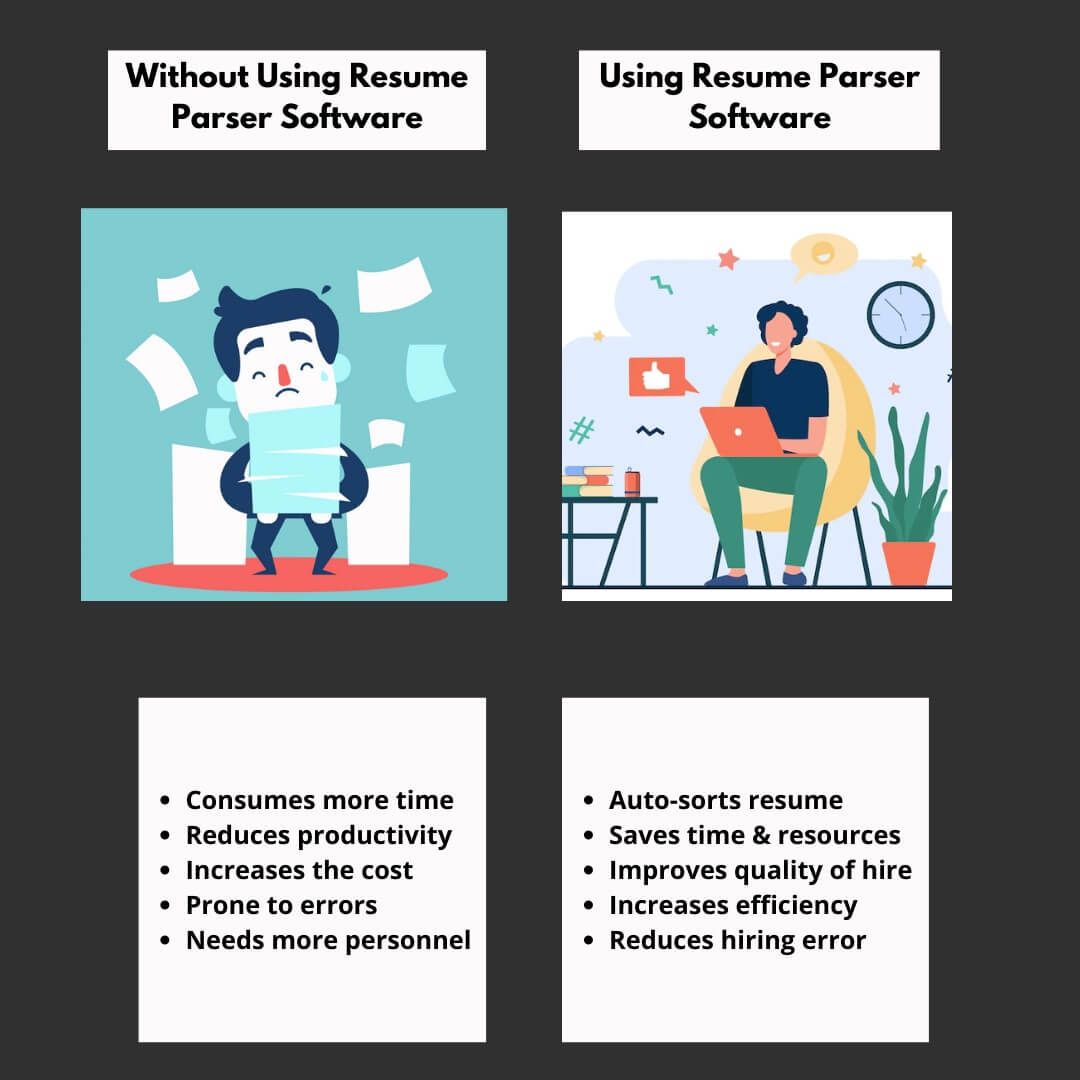
But at the same time, HR recruiters may feel overwhelmed as they have to sift through piles of resumes to find the best talent. Imagine the sheer amount of time they spend scanning each resume to determine the applicant’s suitability for the job opening!
Collating data manually takes a significant amount of time and energy for recruiters. It is also prone to human error and results in increased hiring costs and reduced productivity.
So, how do you make a quick and efficient hiring decision with all the unstructured information cluttering your database? This is where the resume parsing comes in.
Resume parsing software automatically scans the resumes and extracts the applicant’s relevant educational qualifications, work experience, skills, and certifications.
Let’s discuss in detail what resume parsing is, how it works, and the benefits a resume management system offers.
What is Resume Parsing?
Resume Parsing is the method of converting free-form resumes into structured information, suitable for storage, reporting, and manipulation.
Automated resume screening software examines a resume, extracts the desired information, and stores it in a database with a unique entry. It automatically recognizes relevant terms in a CV. Info such as a candidate's educational qualifications, skills used during employment, years of experience using certain skills, and more.
Once the resume has been analyzed, a recruiter can search the database for keywords and phrases to find a list of candidates who are a good fit for the job.
How Does Resume Parsing Work?
Resume parsing begins with uploading all applications for a specific position into the ATS software. This can be done either manually or automatically.
Once the applications are submitted, resume parsing software scans each document and extracts all relevant information and applications based on the needs of the recruiter. Usually, relevant information includes specific job skills, work experience, educational credentials, contact information, and professional certifications
The time hiring managers would have spent manually reading through each application is instead saved by parsing software. This basically identifies and groups the applications with the pertinent information or eliminates those candidates without it.
Types of Resume Parsing
Usually, there are three kinds of resume parsing software available in the market:
1. Keyword-Based Resume Parser
A keyword-based resume parser is the simplest type of parser that identifies words, phrases, and basic patterns in the resume’s text. It then uses simple heuristic algorithms to extract information around those words.
For example, if the HR recruiter is searching for a PIN code, then they would assume the surrounding keywords are an address. One of the disadvantages of this type of parser is that it cannot find data that is not surrounded by specific keywords.
2. Grammar-Based Resume Parser
A grammar-based parsing tool uses numerous grammatical rules to understand the context of each word in the resume or cover letter. It combines specific words and phrases to form intricate sentences that convey the meaning of each sentence in the resume.
This type of parsing is beneficial in understanding the impact of skills in a resume. Usually, it is more complicated than keyword-based parsing but captures more accurate and specific details.
3. Statistical Parsers
A statistical parser seeks to identify the structure of a resume by applying numerical models of text. It captures specific elements of a resume or cover letter by distinguishing between multiple contexts of the same word or phrase.
What Are the Advantages of Resume Parsing?
Resume parsing can help you find the best talent available for a particular position. Let’s discuss some of the other benefits that it offers:
1. JD Match to recommend the right candidates
Resume parsing can help you to find the right candidates that match the job description of your company’s open position. Since the tool can sort candidates quickly based on pre-defined skills, the HR team can screen out unqualified resumes and ensure that only the best candidates are considered for the position. It increases the chances of finding the candidate who is the best fit for the open role.
2. Recruitment Process Acceleration
Resume parsing can save hiring managers hours spent. Tasks such as manually reading through each resume, identifying and sorting resumes with relevant skills and information, and eliminating others. This speeds up the hiring process, thereby saving time and reducing the recruiter’s effort. As a result, HRs can spend their time more efficiently on tasks that cannot be automated, such as interviewing qualified applicants.
3. Record-Keeping Efficiency
Resume parsing software also saves resumes for easy retrieval, keeping them organized and accessible for future needs. This makes it easier for a hiring manager to stay organized and work efficiently, which is important when a job posting brings in hundreds or thousands of applicants.
4. Hiring Errors Minimisation
Using recruitment management software to sort resumes ensures that you do not miss any important keywords in applications. While manually scanning resumes for these words and qualifications can be effective, resume parsing software can scan multiple resumes quickly and with a low chance of error.
5. Data Consistency
A resume parser ensures that your candidate data is consistent regardless of how many resumes you parse per day. Before incorporating a resume parser into HR activities, all you need to do is configure custom parameters and parsing format. Once you've established a data storage system that meets your needs, parsing and analyzing additional candidate data will be a breeze.
Common Challenges of Resume Parsing
Inconsistent formatting: Resumes built with tables, columns, text boxes, or unusual fonts often confuse parsers, especially keyword-based ones. A candidate's work history can end up jumbled or split across the wrong fields simply because their resume used a two-column template.
Scanned and image-based resumes: A parser without OCR (optical character recognition) can't read a resume that's really just a picture of text, which means strong candidates get missed for a formatting reason that has nothing to do with their fit for the role.
Non-standard job titles and skill synonyms: "Growth Marketer" and "Digital Marketing Manager" might describe near-identical roles, but a parser without a strong taxonomy behind it can treat them as unrelated, quietly filtering out qualified applicants.
Regional and language variations: Date formats, address structures, and even the word "CV" versus "resume" differ by country. Parsers built for one region often stumble on resumes formatted for another, which matters if you're hiring across India, the Gulf, or globally.
Over-reliance on keyword matching: Basic parsers reward resumes stuffed with the right buzzwords over resumes that actually demonstrate the skill in context, which can push genuinely strong candidates further down the list.
Data privacy and compliance gaps: Parsed resumes often sit in a database indefinitely unless retention policies are configured. That's a real risk under regulations like India's DPDP Act or GDPR if candidate data isn't stored, accessed, and deleted according to a clear policy.
All of these issues are resolved with Talentpool recruitment software's resume management system. Want to see how? Contact us at info@thetalentpool.ai or schedule a demo.
Best Practices for Using Resume Parsing Software
Pair automation with human spot-checks: Run periodic audits comparing what the parser extracted against the original resume, especially in the first few months. This catches formatting blind spots before they quietly cost you good applicants.
Keep your skills taxonomy current: Job titles and skill names evolve fast, particularly in tech and BFSI hiring. Review and update the synonym lists and keyword sets your parser relies on every quarter, not just once at setup.
Use a parser with genuine NLP, not just keyword matching: Grammar-based or statistical parsers understand context. The difference between "led a team of 5" and "reported to a team of 5" is something keyword parsers routinely miss.
Set clear data retention rules: Decide upfront how long parsed candidate data stays in your system and configure automatic deletion or anonymization after that window, both for compliance and for keeping your database clean.
Test with real, messy resumes before rollout: Don't validate a parser only on clean, well-formatted sample resumes. Run it against scanned PDFs, non-English resumes, and unconventional formats to see how it actually performs on your real applicant pool.
How to Choose the Right Resume Parsing Software
| What to Check | Why It Matters |
|---|---|
| Parsing accuracy | Ask for benchmark accuracy rates on fields like skills, dates, and education, not just a vague "AI-powered" claim |
| Format and OCR support | Confirm it handles PDFs, Word docs, and scanned or image-based resumes, not just clean digital files |
| NLP vs. keyword-based engine | Grammar-based or statistical parsers extract context, not just matching words, which reduces false negatives |
| Multi-language and regional support | Especially important if you're hiring across India, the Middle East, or other multilingual markets |
| ATS and CRM integration | Parsing is only useful if the structured data flows straight into your existing hiring workflow without manual re-entry |
| Customization | Look for configurable fields and taxonomies so the parser adapts to your industry's specific skills and titles |
| Compliance certifications | ISO 27001, GDPR-readiness, and configurable data retention policies matter once you're storing candidate PII at scale |
| Scalability | Check how the parser performs at your actual application volume, not just in a vendor demo with a handful of resumes |
Conclusion
By employing the resume parsing technique in your end-to-end recruitment process, you can streamline the applicant screening process. Resume parsing software can do in seconds what humans can do in hours. Regardless of the size of the firm, investing in a resume parser tool will boost your hiring team's productivity and lower costs. You will get the best candidates for each position every time and with much less effort.
Frequently Asked Questions
Tags
Sanchita Paul
Marketing Communication Specialist
Sanchita Paul is a key member of the Talentpool team, bringing extensive experience in talent acquisition and recruitment technology to help companies build better hiring processes.