
What is Recruitment Sourcing? Best Recruitment Sourcing Strategies to Find the Right Candidate!
Recruitment sourcing is the proactive process of identifying, engaging, and building relationships with potential candidates, including people who aren't actively job-hunting. The strongest sourcing strategies combine employee referrals, social media outreach, internal talent pools, direct outreach, and, increasingly, AI-based candidate matching, so a pipeline already exists by the time a requisition opens, instead of starting from zero.

Ankita Gupta
Marketing Specialist
Quick Overview
- Recruitment sourcing is the proactive work of finding and engaging candidates, including people who are not actively job hunting, before a role even opens.
- Recruitment sourcing is different from recruitment itself, which covers the full hiring cycle from posting through offer and onboarding.
- Beyond the basics - referrals, social media, ATS, advertising, internal talent pools, outreach, and agencies - more advanced teams add Boolean/advanced search, talent communities, competitor talent mapping, and re-engaging strong candidates from past rounds.
- AI is changing sourcing by automatically ranking passive candidates and resurfacing past applicants for new roles, cutting down the manual searching recruiters used to do one profile at a time.
- A sourcing strategy is measured through source of hire, conversion rate, time-to-fill, response rate, and pipeline health.
Introduction
Recruiting the right talent is easier said than done.
As the demand for top talent is rapidly growing, finding competent individuals will likely continue to be a significant recruiting challenge for businesses worldwide. Organizations are seeking innovative ways to create effective strategies to attract and retain talent.
In this blog, we will explore the best recruitment sourcing strategies that can help organizations attract top talent and improve their hiring outcomes. It will also help them build a strong employer brand.
Further, let us dive in and discover the most effective recruitment sourcing strategies to find the right candidate!
What is Sourcing in Recruitment?
Recruitment sourcing is the strategic process of identifying and attracting the right candidates to fill job vacancies within an organization.
It starts by identifying the vacancies and creating a detailed job description that outlines the necessary qualifications, experience, and skills. The organization then identifies potential candidate sources and actively reaches out to potential candidates through targeted emails, social media engagement, or recruitment events.
A well-planned recruitment sourcing strategy is essential to ensure that an organization attracts and hires the best talent available to fill its staffing needs.
Sourcing vs. Recruitment: What's the Difference?
People often use "sourcing" and "recruitment" interchangeably, but they are not quite the same thing, and the distinction matters for how you actually build a hiring strategy.
Recruitment sourcing is the upfront, proactive part, identifying and reaching out to potential candidates, including people who are not actively looking, before a specific role even opens.
Recruitment is the complete, end-to-end hiring process: sourcing feeds into it, but recruitment also covers screening, interviewing, offer negotiation, and onboarding.
Why Is Recruitment Sourcing Important?
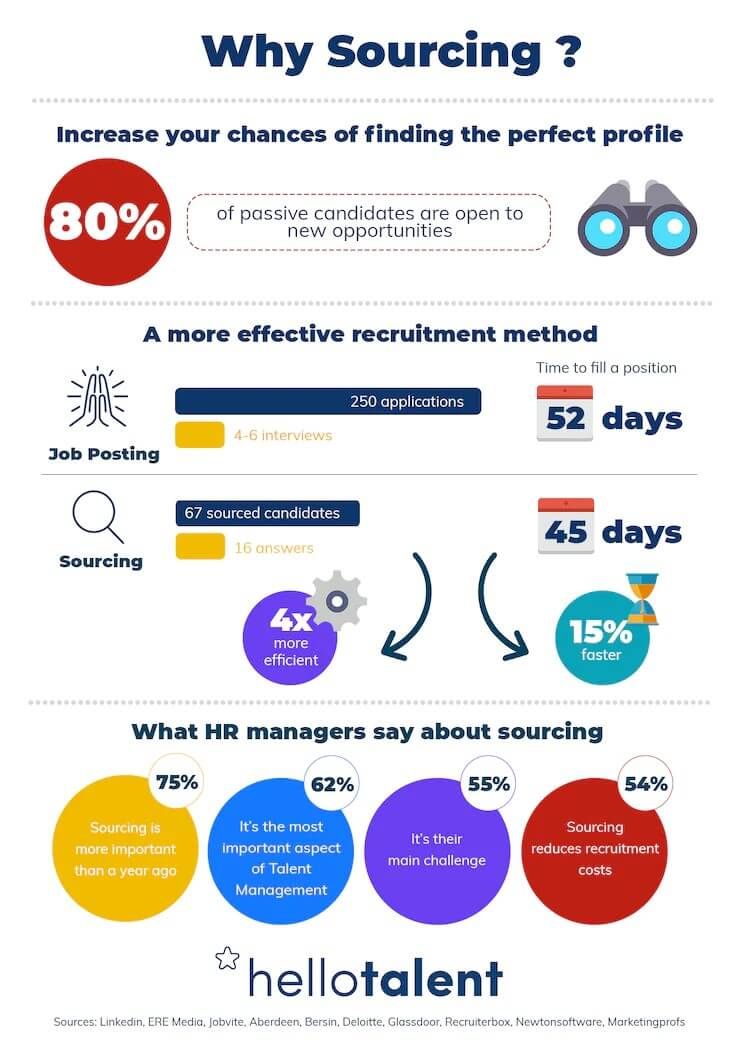
Do you know that 73% of talent acquisition leaders say that talent sourcing is a top priority for their organization, as it helps them fill positions faster and with better quality candidates?
Indeed, recruitment sourcing is critical for organizations to attract the right talent, reduce hiring costs, and improve their overall hiring outcomes.
What are the Benefits of Sourcing in Recruitment?
1. Access to a Wider Candidate Pool
Recruitment sourcing allows organizations to reach out to a wider pool of potential candidates beyond their immediate network. By leveraging various sources such as job boards, social media platforms, and recruitment agencies, organizations can tap into a diverse range of candidates with different backgrounds, skills, and experiences.
2. Better Candidate Selection
Recruitment sourcing enables organizations to identify and screen potential candidates more efficiently and effectively. This ensures that only the most qualified and suitable candidates are selected for further consideration, reducing the risk of costly hiring mistakes.
3. Reduce Time-to-Hire
A well-designed recruitment sourcing strategy can significantly reduce the time it takes to fill a job vacancy. This is achieved by leveraging different sources and techniques to reach potential candidates quickly and efficiently, thereby minimizing the time-to-hire and resources required for the hiring process.
4. Boost Employer Branding
Candidate sourcing also plays a crucial role in shaping an organization's employer brand. A positive and professional approach to recruitment sourcing can create a strong impression on potential candidates. It can also promote the organization as an attractive employer and enhance its reputation in the market.
Modern candidate tracking software like Talentpool comes with an integrated candidate sourcing tool that helps recruiters identify and engage relevant candidates faster by automating search, ranking profiles, and organizing talent pipelines.
How Does the Recruitment Sourcing Process Work?
- Define who you are actually looking for before reaching out to anyone: the must-have skills, experience level, and the kind of candidate likely to succeed in the role.
- Map out where those candidates actually spend time. A senior engineer might be on GitHub or in a niche Slack community; a BFSI compliance hire is more likely reachable through industry associations or LinkedIn groups.
- Reach out with a message that is not generic. Personalized outreach converts significantly better than a templated "we have an opening," especially with passive candidates who are not looking in the first place.
- Nurture the relationship, not just the application. Not every good candidate is ready to move right now, and sourcing is as much about staying on someone's radar as it is about filling today's opening.
- Feed the pipeline straight into your applicant tracking system, so nothing falls through the cracks.
- Keep the pool warm even after you hire. The candidates you didn't pick this time are often exactly who you need for the next opening.
Done well, this turns sourcing from a reactive process into a standing pipeline that is already half-built by the time a requisition gets approved.
What are the Most Effective Sourcing Strategies in Recruitment?
To build a better sourcing strategy, you need to prioritize activities that develop your talent pipeline. It helps in hiring the best candidates for your current and future roles.
Let us discuss some top sourcing strategies in recruitment:
1. Employee Referral Programs
Employee referral programs are one of the most effective recruitment sourcing strategies. These programs encourage employees to refer qualified candidates from their network for open job positions.
According to a study by Jobvite, employee referrals are the number one source of quality hires, with a 40% referral-to-hire conversion rate. Referral candidates are more likely to be a good fit for the organization's culture and requirements, resulting in faster time-to-hire and reduced hiring costs. Additionally, referral candidates tend to have higher retention rates compared to candidates from other sources.
Also Read: 4 Reasons Why Your Employee Referral Program is Not Working
2. Social Media Recruitment
Social media recruitment involves using social media platforms such as LinkedIn, Facebook, and Twitter to source and attract potential candidates. This strategy allows organizations to reach a wider audience, including passive job seekers who may not be actively looking for new opportunities.
Social media recruitment is particularly effective for organizations looking to attract candidates in niche industries or for hard-to-fill positions. Recruiters can use social media to promote job openings, share company news and culture, and connect with potential candidates. It also allows organizations to build and maintain their employer brand, showcasing their company culture and values to potential candidates.
3. Applicant Tracking System (ATS)
An applicant tracking system is a software that automates and streamlines the recruitment process, from job posting to candidate selection. ATS software assists recruiters in screening and filtering candidates based on qualifications, experience, and other criteria, ensuring that only the most qualified candidates are considered for the job.
Additionally, applicant tracking software can save recruiters time and reduce hiring costs by automating time-consuming tasks such as resume parsing and candidate communication. ATS can also provide valuable insights into recruitment metrics such as time-to-hire, cost-per-hire, and source of hire, allowing recruiters to optimize their recruitment strategy and improve their hiring outcomes.
However, effective use of ATS requires a strategic approach and a good understanding of the target audience.
4. Recruitment Advertising
Recruitment advertising involves promoting job vacancies through various channels such as job boards, career fairs, and newspaper advertisements.
According to a report by the Society for Human Resource Management (SHRM), 72% of organizations use online job boards as a recruitment strategy and 59% use career fairs. This strategy allows organizations to reach a large audience and attract candidates who are actively searching for job opportunities.
5. Internal Talent Marketplace
According to a survey by LinkedIn, 70% of companies believe that talent pooling is a valuable strategy for recruiting.
An internal talent marketplace consists of a database of existing employees who are interested in career advancement opportunities within the organization. This talent pool can be leveraged by recruiters to fill open positions and promote career growth within the organization.
The primary advantage of an internal talent marketplace is that they enable recruiters to access a pool of high-quality candidates who are already familiar with the organization's culture and requirements. Internal candidates are more likely to be a good fit for the job and have a higher retention rate compared to external hires. Additionally, internal talent pools can reduce hiring costs and time-to-hire, as the recruitment process is shorter and less resource-intensive compared to external hiring.
6. Outreach Messages
Outreach messages are used by recruiters to connect with potential candidates who are not actively seeking new job opportunities. These candidates may be passive job seekers or currently employed in other organizations. They enable recruiters to access a pool of high-quality candidates who are not actively searching for job opportunities.
Effective outreach messages should be personalized, engaging, and tailored to the target audience. Recruiters need to research their target audience to understand their needs, interests, and career aspirations, and craft messages that resonate with them. Additionally, outreach messages should clearly communicate the value proposition of the organization and the job opportunity, highlighting the benefits and opportunities available to the candidate.
7. Recruitment Agencies
Recruitment agencies can also be a valuable resource for organizations in their recruitment sourcing efforts. These agencies specialize in finding and screening potential candidates and can help organizations fill job vacancies quickly and efficiently. Recruitment agencies have access to a broad network of candidates and can provide valuable insights into the job market.
However, this strategy can be costly and may not be suitable for all job positions.
Advanced Recruitment Sourcing Strategies
The seven strategies above are the foundation. If your team is already running referral programs and posting on social media, here's where more mature sourcing teams go next:
- Boolean and advanced search: Structured search operators across search engines and platforms like LinkedIn to surface highly specific profiles, useful when you are hunting for a narrow combination of skills a plain keyword search won't catch.
- Talent communities and events: Building a presence in industry forums, Slack groups, or meetups where your ideal candidates already spend time, instead of only reaching them through job postings.
- Competitor talent mapping: Systematically tracking who works in comparable roles at companies you compete with for talent, so you already know who to approach when the right opening comes up.
- Silver-medalist re-engagement: Revisiting strong candidates from past hiring rounds who were not selected the first time. They have already been vetted once, and circumstances change.
How to Build an Effective Talent Sourcing Strategy?
- Start with your hiring roadmap, not your open roles. If you know you're hiring 15 engineers next quarter, sourcing should start now, not when the first requisition is approved.
- Pick 2-3 channels and go deep, not seven channels shallow. A strong referral program plus focused, personalized outreach on one platform usually beats a scattered presence everywhere at once.
- Build your internal talent pool deliberately. Every candidate who applies but isn't hired, and every passive candidate who responds to outreach, should land in a searchable database, not a forgotten spreadsheet.
- Assign clear ownership. Sourcing falls through the cracks fastest when it is "everyone's job"; someone needs to actually own outreach and track what is working.
- Review and adjust quarterly. What worked a year ago may not work today; track which channels are actually converting and shift effort accordingly.
How to Measure Recruitment Sourcing Performance?
A sourcing strategy you cannot measure is just a guess with extra steps. Worth tracking consistently:
- Source of hire: Which channel (referrals, social, direct outreach, agencies) actually produces candidates who get hired, not just candidates who apply.
- Sourcing-to-hire conversion rate: Of the candidates your team proactively sourced, what share actually get hired? High volume with low conversion may be costing more effort than it is worth.
- Time-to-fill by source: Internal talent pools typically move faster than cold outreach to passive candidates; knowing this helps you pick the right channel for urgent roles.
- Candidate response rate: For outreach-based sourcing specifically, this tells you quickly whether your messaging is landing or being ignored.
- Pipeline health over time: Tracking how many qualified candidates sit in your talent pool shows whether you're building a cushion for future roles or starting from zero each time.
Reviewing these regularly is what turns sourcing from a set of activities you hope are working into a strategy you can actually improve.
Conclusion
Building a powerful recruiting sourcing strategy is a pivotal part of a productive talent acquisition process that nets results. By using the right sourcing channels and tracking the right metrics, your organization can build a strong candidate pipeline and land experienced talent that fits your company culture well.
Talentpool AI recruitment software keeps dedicated employee referral and vendor management modules feeding into the same centralized talent acquisition system as the rest of your pipeline. So you can see which channel is actually earning its budget and allocate resources accordingly.
We offer easy job board integrations and a branded career page you can have live in a day, giving you one more clean, trackable source. With advanced search and position sets, you can also find top candidates from your existing database and create reserve role-specific talent benches.
Want to see how Talentpool can help you streamline your candidate sourcing process? Book a personalized demo now!
Frequently Asked Questions
Tags
Ankita Gupta
Marketing Specialist
Ankita Gupta is a key member of the Talentpool team, bringing extensive experience in talent acquisition and recruitment technology to help companies build better hiring processes.